
Console History / Linux / Open Hardware
The PS2
Linux Kit
RAM: 32 MB · Storage: 40 GB IDE · Price: $199 (2002)
In 2002, Sony did something no one expected: it sold a Linux kit for the world's most popular games console. What followed was one of the strangest chapters in computing history — part hobbyist dream, part corporate tax manoeuvre, part open-source experiment gone feral.
The PlayStation 2 launched in 2000 as the fastest-selling consumer electronics device ever made. Its Emotion Engine CPU — a 295 MHz MIPS-based chip with a floating-point unit Sony claimed rivalled a supercomputer — attracted attention from engineers, academics, and Linux enthusiasts long before any official tools existed. The hardware was extraordinary for its price. People wanted in.
Japanese Linux enthusiasts had requested access to the PS2's hardware for development, and Sony, surprisingly, listened. A beta run of 2,000 units launched in Japan in 2001 and sold out almost immediately. Due to the large numbers of requests, SCEI ended up providing approximately 7,900 units to Linux enthusiasts before the full release. The demand was real and it was loud.
On May 22, 2002, the PS2 Linux Kit launched worldwide. For around $199 — roughly $350 in today's money — you received a 40 GB internal IDE hard drive, Ethernet adapter, USB keyboard and mouse, a sync-on-green VGA cable, two DVDs containing the runtime environment and software packages, and printed manuals. It turned the PlayStation 2 into a genuine, if constrained, Linux workstation.
The Linux kit's primary purpose was amateur software development, but it could be used as one would use any other computer. In practice, this meant a Window Maker desktop, a sparse collection of lightweight applications, and a humbling awareness of how little 32 MB of RAM actually is.
Noted open-source software that compiled on the kit included Mozilla Suite, XChat, and Pidgin. Lightweight applications better suited to the PS2's 32 MB of RAM included xv, Dillo, Ted, and AbiWord. For many users it became a dedicated MP3 jukebox or an IRC machine — niche, slow, but real. You could write code, connect to the internet, and print documents. Slowly. Very slowly.
⚠ The DVD restriction
The kit deliberately blocked access to the DVD-ROM drive for general data use. Sony's piracy concerns meant you could read PS1 and PS2 game discs, but not arbitrary data DVDs. The machine was open — but only up to a point.
The kit was great for programming hobbyists and a platform for learning Linux. Universities bought them in numbers. Sony itself sold kits to academic institutions as a low-cost parallel computing research platform — the PS2's vector units made it genuinely interesting for certain numerical workloads. The gap between toy and tool was thinner than it looked.
BlackRhino: the community takes overSony's official distribution was usable but conservative. The community, predictably, went further. BlackRhino was a free Debian-based GNU/Linux software distribution for the Sony PlayStation 2, containing over 1,200 software packages to aid in using and creating programs on the machine. Where Sony shipped a curated but limited environment, BlackRhino gave you the Debian package manager and everything that implied.
Built by xRhino, Inc. and hosted at
blackrhino.xrhino.comapt-getYou can now maintain your PS2 as a standard Debian box.
The community kept the flame alive long after Sony quietly shut down the official
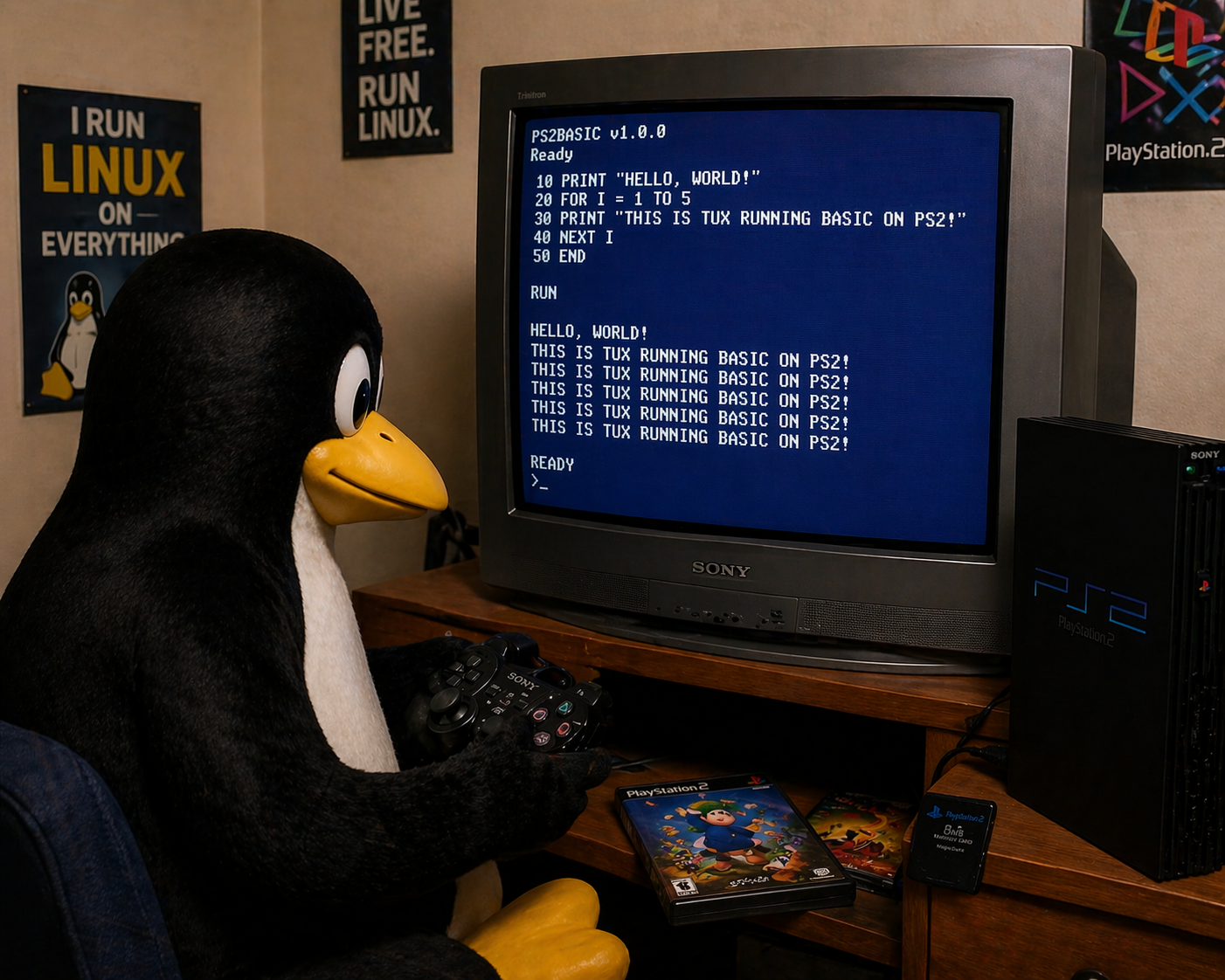
playstation2-linux.comBefore Sony sold a Linux kit, it tried something far more audacious and considerably cheaper: it bundled a BASIC interpreter with every PAL-region PS2 and dared the European Commission to call it a games console.
The scheme centred on import tariffs. Sony would argue that since the PlayStation 2 could be programmed by users, it should be considered a home computer, not a games machine. The Japanese giant wanted to persuade European Commission customs officers that the PlayStation 2 was a computer because the company would otherwise have to pay a two per cent import duty. Two per cent sounds modest until you're selling tens of millions of units. At those volumes, the savings were enormous.
Demo discs containing Yabasic shipped with all PAL-region PS2 consoles between 2000 and 2003 as the vehicle for this argument. Yabasic was a real, open-source implementation of BASIC — you could genuinely write programs with it, draw graphics, read input. It was not a fake. Whether it was sufficient to reclassify a DVD-playing games console as a home computer was another matter entirely.
The attempt failed to convince the courts in Europe that the console should be classified as a home computer. Sony lost the case. The two per cent duty stood — though the story has a dark comic coda: video game consoles are no longer subject to this import tax anyway, rendering the entire legal battle moot in retrospect.
↻ The exploit angle
Decades later, Yabasic had its revenge. Security researcher CTurt discovered that the BASIC interpreter shipped on those PAL demo discs contained a buffer overflow vulnerability. By exploiting it, any European PS2 owner with an original demo disc could gain arbitrary code execution — no modchip, no expensive kit required. The tax-dodge disc became a hacking tool.
The PS2 Linux Kit directly influenced the PS3's OtherOS feature, which allowed users to install Linux on early PlayStation 3 consoles. That too was later removed in 2010, leading to lawsuits and backlash. Sony kept reaching for the same idea and kept pulling back from it.
The kit was discontinued when the slim PS2 models arrived — their lack of an expansion bay made the hardware incompatible. In 2010, the US Air Force built the Condor Cluster using 1,760 PS3 consoles running Linux, a direct descendant of the same logic that had put Window Maker on a games console eight years earlier: Sony's hardware offered extraordinary compute-per-dollar, and the Linux kit had proved people would use it seriously.
What the PS2 Linux Kit actually was, underneath the tax arguments and the hobbyist enthusiasm, was a strange act of corporate honesty. Sony admitted, in hardware and software and printed manuals, that the line between a games console and a computer had always been artificial — and for a brief, strange window around 2002, they sold you the tools to prove it.